
When the Work Finds Its Place
There are times in an artist’s development when something begins to shift. The work starts to find its way beyond the field, the post, and the critique, and into the broader conversation. Not through a single breakthrough, but through a series of recognitions that begin to align.
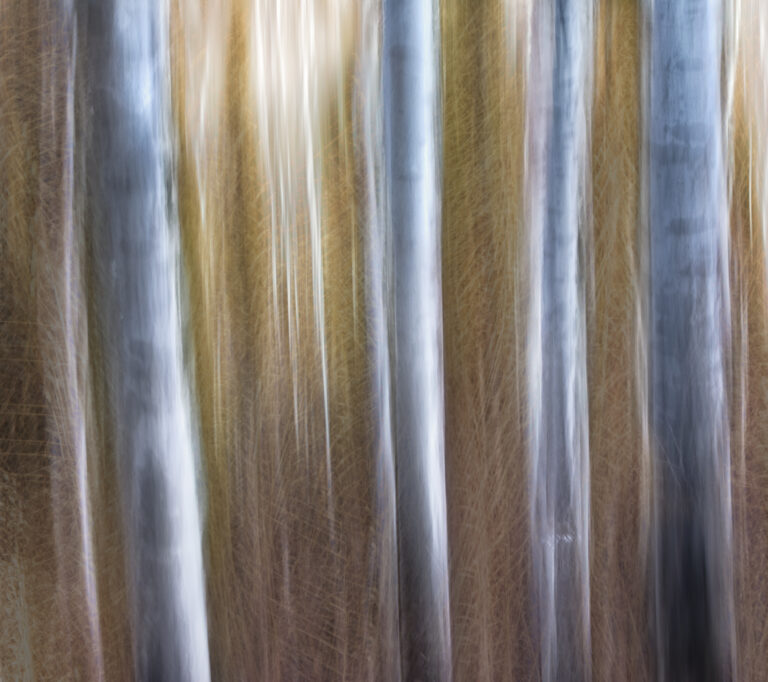
That is where we find Robert DenUyl. His series Ghosts of the Forest, recently featured by Dodho Magazine, arrives not as an isolated success but as part of a growing body of work that is being seen, placed, and collected across multiple venues.
Over the past several months, Robert’s work has moved beyond the internal structure of the Mentor Program and into the broader photographic community. His series Ghosts of the Forest has been selected as a finalist feature in Dodho Magazine—a publication known for highlighting contemporary photographic voices exploring abstraction and personal vision.
But this recognition does not stand alone.
Alongside these placements, his work began to find a place with art collectors—an important distinction. Recognition validates the vision; purchases confirm that the work resonates beyond the artist.
- His work is currently being exhibited across multiple galleries and publications:
- Unmoored — exhibited at Decode Gallery as part of the Solitude exhibition
- Hymn of Rock and Water — featured in Black Box Gallery (Field Work: Trees and Water)
- Pasture to Peak — finalist selection in Landscape Photography Magazine Issue 160 on page 102 in their Best Photos of 2025 assignment
- Fall Haze and Reflected Glory — selected for the Significant Colour exhibition at PH21 Gallery
- Valley Sanctuary — exhibited at Dusk Gallery in Santa Fe, NM as part of the Nostalgia exhibition
- Ghosts of the Forest — also accepted into the Ten Moir All Abstract exhibition
The Work Itself
What makes Ghosts of the Forest compelling is not simply its abstraction, but its restraint. These images do not announce themselves. They ask the viewer to slow down.
Robert works within the landscape, but not in the traditional sense. The forest is not presented as a place—it becomes a field of relationships: tone, gesture, rhythm, and quiet tension. Trees dissolve into suggestion. Light becomes structure. Form is reduced through deft camera movement but not emptied. Throughout the collection, there is a sense that something is present but not fully revealed. Thus, this is where the title begins to carry weight.

The “ghost” is not literal. It exists in the space between recognition and ambiguity—where the viewer begins to project meaning into the image. In this way, the photographs operate less as documents and more as experiences.
Values Within the Work
What gives Ghosts of the Forest its strength is not simply its visual language, but the discipline behind it.
There is a restraint in these images that resists the impulse to resolve too quickly. They do not rely on spectacle or overt drama. Instead, they are constructed through subtle relationships—tones that nearly disappear, forms that suggest rather than define, and compositions that ask the viewer to stay longer than they might expect.
Equally important is the cohesion of the Collection. These images are not operating independently; they build on one another. Each frame deepens the visual language, reinforcing a consistent voice that holds the work together as a unified whole rather than a collection of individual successes.
And within that cohesion, there is space. The photographs do not insist on meaning. They leave room for the viewer to enter, to question, and to find their own connection. That openness is not accidental—it is a choice, and one that gives the work its staying power.

Closing Thought
Recognition has a way of marking progress, but it does not define the work. Exhibitions will rotate, publications will move on, and new opportunities will take their place. What remains is the question of whether the work continues to hold—whether it invites return, whether it reveals something new over time, whether it lingers.
Ghosts of the Forest suggests that this is not a moment of arrival, but a continuation. And perhaps that is the more important measure—not how widely the work is seen, but how long it stays with us once we have.