
Protecting the Work You Create
Many of our Mentor Students are publishing their work, finding success in online and brick-and-mortar gallery exhibitions, and selling work to collectors. This dramatic increase in public exposure of your work means it is wonderful and needs to be celebrated, but it also means you need to seriously consider copyrighting it. Here is why.
Today, images move quickly and what once required effort to reproduce now takes seconds. Photographs are lifted from websites, shared across platforms, and reused in ways the artist never intended. The reality is simple: if your work exists online, it can be taken.
In the United States, your photographs are automatically protected by copyright the moment you create them. But in a digital environment where images are easily copied, scraped, and redistributed—sometimes even at scale—ownership alone is not enough. Your most valued work needs to be registered.
A Note on Metadata and First-Line Protection
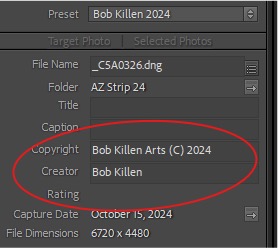
Before we even reach registration, there is a simple step every photographer should take.
When importing images into your catalog in Adobe Lightroom, embed your copyright notice and contact information in the metadata preset. This includes your name, copyright claim, and, when appropriate, a website or email.
This does not prevent theft. But it does establish authorship and provides a direct path back to you if your image is used improperly or discovered by a legitimate buyer.
Think of metadata as your signature embedded within the file. It travels with the image, even when the image travels beyond your control..

Ownership vs. Protection
Copyright exists the moment you create an image. You own your work. But ownership and protection are not the same thing. If your work is not registered with the U.S. Copyright Office, your ability to enforce your rights is limited. You cannot file an infringement claim in federal court, and recovering damages becomes difficult.
Registration is what gives your copyright weight.
What Does “Published” Mean?
A photograph is generally considered published when it has been made publicly available.
That includes:
- Your website
- Social media platforms such as Instagram or Facebook
- Online newsletters
- Magazines, exhibitions, or gallery releases
If an image can be viewed by the public without restriction, it is typically considered published. Unpublished work, by contrast, is work that remains in your archive and has not yet been shared publicly.
This distinction matters because the Copyright Office requires you to group images as published or unpublished when registering them.
Group Registration and Fees
The U.S. Copyright Office has made registration more accessible than many photographers realize. At the time of writing, photographers may register up to 750 images in a single application for approximately $85.
There are two primary pathways:
- Unpublished Images:
Up to 750 images that have not yet been publicly shared. - Published Images:
Up to 750 images, provided they were published within the same calendar year and include accurate publication information.
For current details and to begin the process, visit:
https://www.copyright.gov/registration/photographs/
This is not simply administrative work. It is part of your professional practice.
Why Registration Matters
If your work is registered, especially within a short window of publication, you gain access to statutory damages and legal fees in the event of infringement.
That changes everything. It gives your work standing.
For those beginning to sell prints, license images, or build a public presence, this matters. You are no longer just creating photographs—you are creating intellectual property.
NPPE Recommended Workflow: Registering Your Work
As your photography moves into public space, copyright registration should become part of your creative routine—not an afterthought
- Track When Work Is First Shared
The moment an image appears publicly, it is considered published. Keep a simple log with image names and first publication dates. - Separate Published vs. Unpublished Work
Divide your images into two groups before registering. These must be submitted separately. - Register Valuable Work in Batches (Quarterly or Annually)
You do not need to register everything you shoot. You want to register work that has marketable or literary value. A consistent schedule keeps the process manageable and ensures your work is protected as it enters the marketplace. - Group Strategically
You may include up to 750 images per submission. Published images must fall within the same calendar year. - Use Consistent File Naming
Clear naming helps you stay organized and protects you if enforcement is ever needed. - Register Before Problems Arise
Registration is most powerful when done early—before infringement occurs.
A Final Thought
We often think of photography as the act of creating images. But for those building a body of work, exhibiting, or entering the marketplace, you are also building an archive of intellectual property.
Treat it that way.