
Small Towns at Night
Photography as Narrative, After the Lights Go Out
from W. Scott Olsen
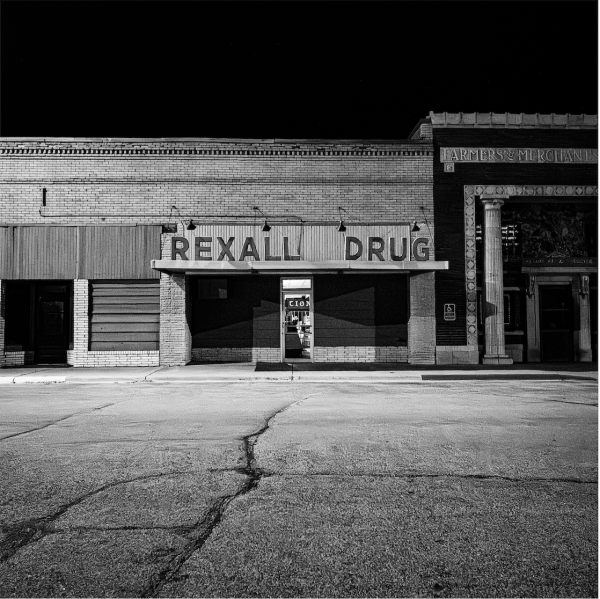
W. Scott Olsen’s exhibition Small Towns at Night ends this week, and I want to encourage everyone to see it. The emotional rewards of standing before each print cannot be fully described on a page. You need to experience it in person.
If you can’t be there, let me share a few thoughts about this exceptional body of work.
Most of us pass through small towns during the day, when stores are open, streets are busy, and life is visible. Scott Olsen photographs them at night—when the businesses are closed, the sidewalks are nearly empty, and the narrative becomes something we must imagine rather than observe.
In Small Towns at Night, Olsen creates photographs that function the way good essays do: they suggest more than they say. Closed storefronts, civic buildings after hours, and streets illuminated by a single light source become stages where something has already happened—or is about to.
The absence of people is not an omission. It is the point.
Shared Influences
Olsen’s work sits comfortably in the lineage of American narrative photography—echoing the quiet tension of photographers such as Walker Evans and Robert Adams, in which meaning emerges through restraint, sequencing, and attention to the overlooked.
But unlike pure documentary traditions, Olsen’s photographs are inseparable from his life as a writer. Each image feels less like a record and more like a paragraph—part of a larger, unfolding text.
A Mentor to Mentors
In addition to his photographic practice, Professor Olsen is a widely published writer, educator, and a Contributing Editor at Frames magazine. He has long been a valued supporter of the NPPE Mentor Program, in which he reviews student portfolios and written projects, consistently emphasizing clarity of intent and narrative coherence. His guidance in fine art photography has proven invaluable to our emerging growth artists’ development and professional growth. We are proud to support him just as he has supported our students.
That same commitment is visible here.
The Gallery Exhibition
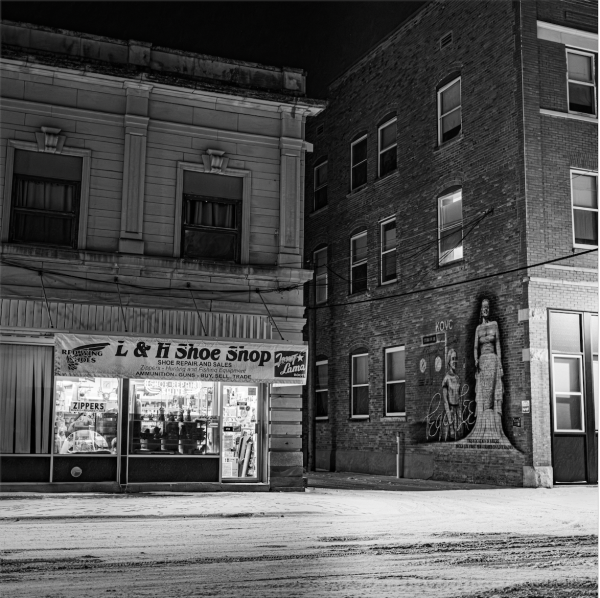
The photographs in Small Towns at Night are not about people, yet they are deeply human. Closed storefronts, quiet streets, and civic buildings after hours become stages for stories that are no longer unfolding but not yet finished. These are places where something has already happened—or might happen again—and Olsen allows that uncertainty to remain intact.
There is no single narrative here. Instead, each of the 20 black-and-white images functions like a paragraph in a longer essay, inviting the viewer to pause, reflect, and imagine what lies beyond the frame.
This is artwork that will stay with you long after you leave the gallery.
Dale’s Grocery, Ulen, Minnesota
In Dale’s Grocery, time feels suspended. The building sits beneath a lone streetlight, its painted name still visible, still asserting identity. We are left to wonder whether the grocery is still open—or when it closed—and what role it once played in the rhythms of daily life.
Nothing in the photograph resolves those questions. Olsen does not tell us what this place was, or what it has become. The image becomes less about a specific business and more about the way memory lingers in physical space. The photograph holds presence without explanation, allowing the viewer’s own experience to complete the story.

Hardware Store, Barnesville, Minnesota
In Barnesville, a single crack in the pavement leads directly toward the darkened entrance of a hardware store. It is a quiet compositional gesture, but a powerful one. The line suggests movement, habit, intention—someone once walked this path repeatedly.
Now, the store is closed. The street is empty. What remains is not action, but evidence of action. Olsen’s narrative approach is clear here: meaning does not come from what is happening, but from what has already occurred—and what has been left behind.

An Invitation, not a Conclusion
Small Towns at Night does not tell us what to think about these places. It offers no solutions and makes no judgments. Instead, it invites us to notice—to look carefully at moments we might otherwise miss—and to consider how meaning accumulates quietly over time. Each viewer will come away with a different interpretation, shaped by personal history and lived experience. That openness is not a weakness of the work. It is its strength.
When the lights are still on, but the town has gone quiet, the story has not ended. It has simply changed its voice.
